

A Neutral Density filter, short as ND filter. It is a type of optical filter that reduces the intensity of specific wavelengths of visual and near infrared light without altering the color balance of the scene. The neutral part means that it doesn’t introduce a color cast, and density refers to its light-blocking ability.
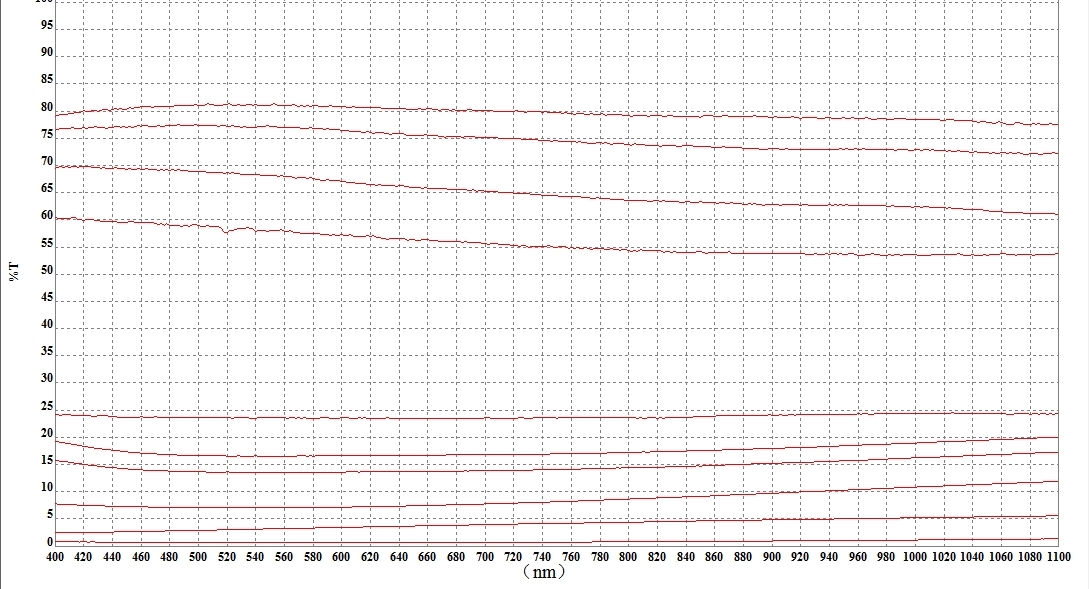 |
| Picture 1: Neutral Density Filters Spectral Graph measurement |
How does a neutral density filter work?
An ND filter is essentially a darkened piece of glass or resin placed in front of a lens. It absorbs or reflects a portion of the incoming light, allowing only a fraction to reach the camera sensor. Because it attenuates all visible wavelengths evenly, it doesn’t change the relative color of the image but just its brightness.
What are difference between reflective type and absorbs types of neutral density filter?
According to the differences in the principle of light reduction, there are interference type and absorptive type ND filters.
- The interference type ND filter is made by depositing a layer of dielectric film on a transparent glass substrate. It works by reflecting away excess light.
Neutral Density Filter, ND filter, Reflective type, Size 105*105*0.7mm, Support Customized
- The absorptive type ND filter, normally called as Neutral Density Glass, is obtained by adding light-absorbing substances during the glass melting process, making the material inherently dark gray, and reducing light by absorbing it.
ZAB00,ZAB02,ZAB2,ZAB5 Neutral Density Glass, Selective Absorption Neutral Grey Color Filter Glass
How to measure ND Strength?
The light‑stopping power is expressed in several ways:
- Optical density: each 0.3 reduces light by one stop,e.g., 0.3, 0.6, 0.9, 1.2…etc.
- Filter factor:the multiplier of exposure time needed, e.g., 2×, 4×, 8×…etc.
- ND number: refer to the filter factor, e.g.ND2, ND4, ND8, ND1000…etc.
- Stops of light reduction: 1‑stop, 3‑stop, 6‑stop, 10‑stop, etc. e.g. A 3‑stop ND filter lets through only 1/8 of the light, while a 10‑stop ND (very dark) lets through about 1/1000.