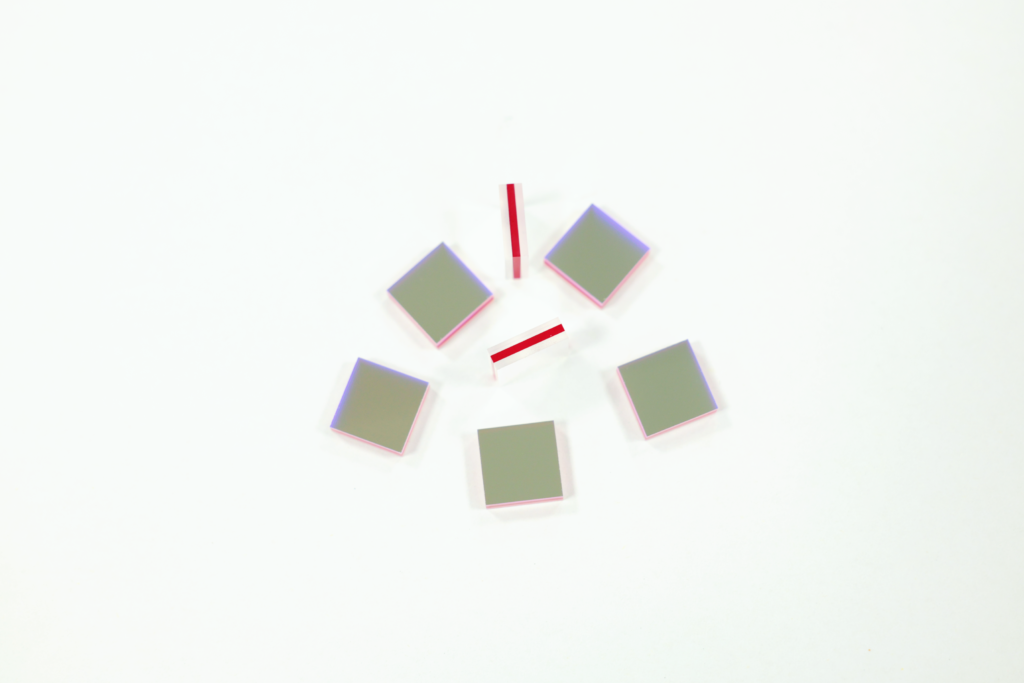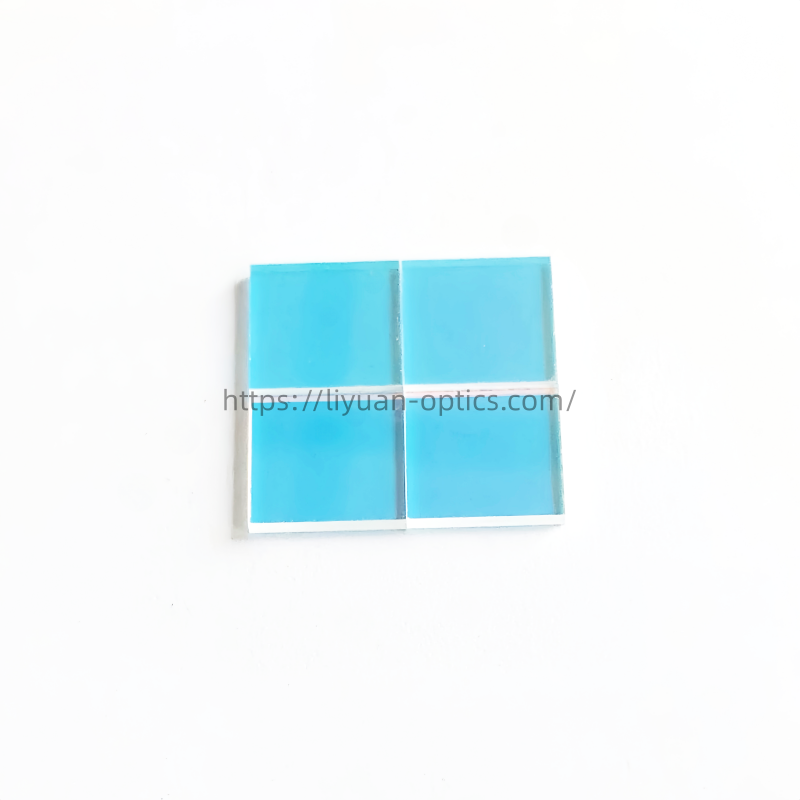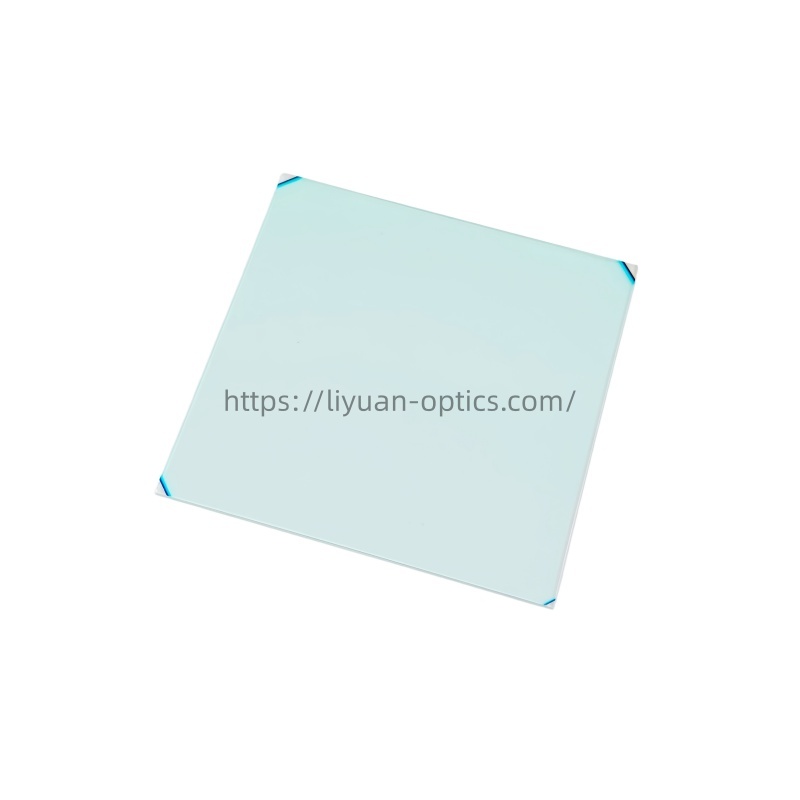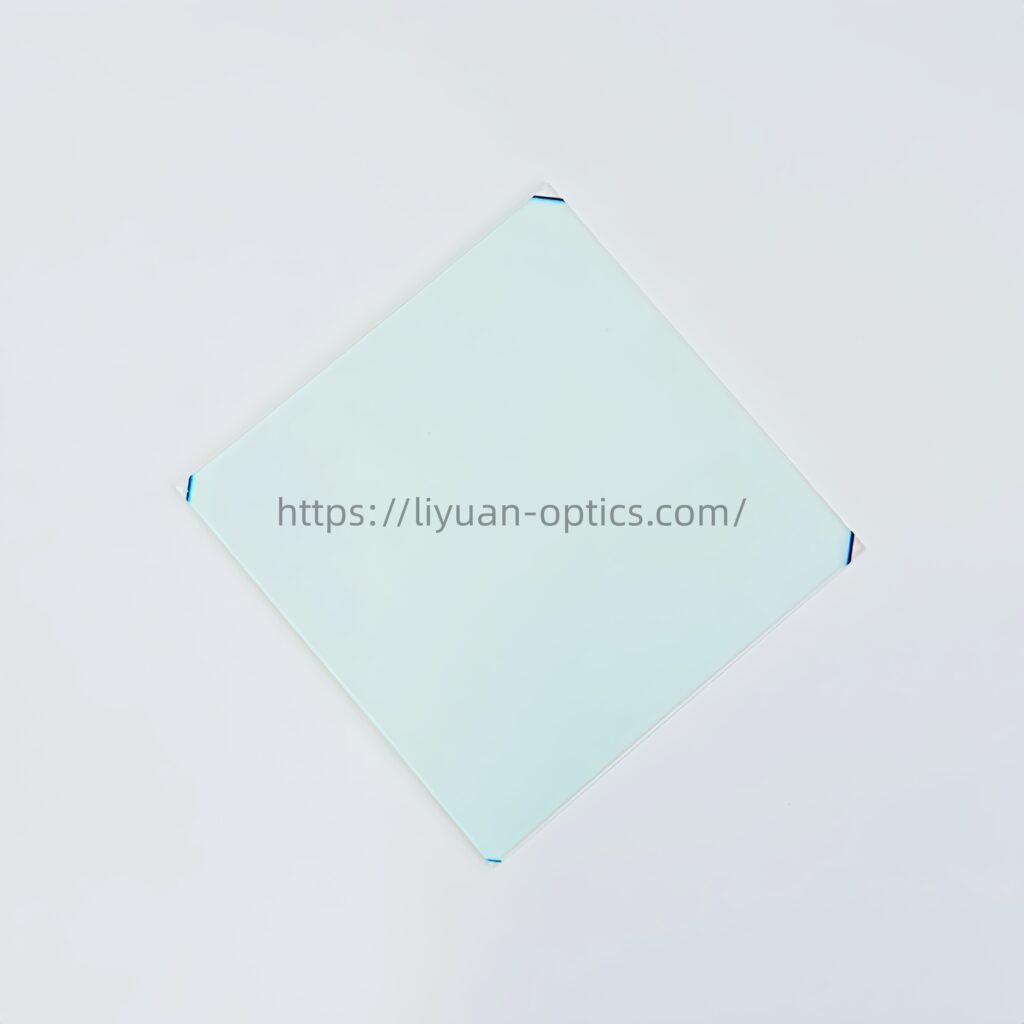



1.Product Descriptions:
| Characteristics: | 450 & 850nm Dual Bandpass Filter |
| Type: | Bandpass Filter |
| Cut-off Wavelength(in mm): | 450nm ± 5nm, 850nm ± 5nm |
| Peak Transmittance(%) : | >85% |
| Full Width at Half Maximum(FWHM) | 10nm – 40nm or specified |
| Optical Density (OD): | OD 2 – OD3 |
| Shape: | Round, Square, Custom Shape |
| Color: | Blue |
| Angle of Incidence(AOI) | 0° or 45° |
| Surface Quality: | 60/40 scratch-dig |
| Dimension(mm): | Specified** |
| Thickness(mm): | specified |
| Substrate: | K9, BK7,Quartz Glass |
| Remark: (1)Spectral range:350-1100nm (2) Size customized: 86x86mm, 80x80mm, other can customized, max. 300x300mm (3) Thickness available: 0.21、0.3、0.55、0.7、1.0、1.1、1.5、1.8、2.0、3.0mm…etc. | |
2.Measured Spectral Graph – 450 & 850nm Dual Bandpass filter:
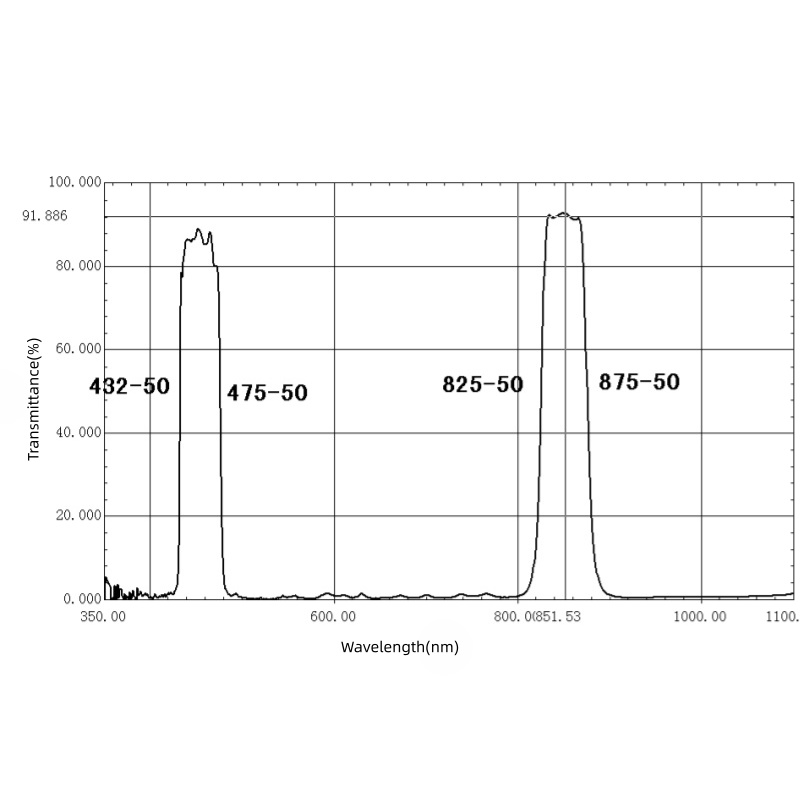 |
| Picture 1: 450 & 850nm Dual Bandpass Filters Spectral Graph measurement |
3.What is the difference between a dual bandpass filter and a standard (single) bandpass filter?
The core difference between a dual bandpass filter and a standard (single) bandpass filter is that a standard bandpass filter focuses on a single specific spectral channel, while a dual bandpass filter integrates two spectral channels into a single component.
4.What is typical application for 450 & 850nm Dual Bandpass Filters?
A 450 & 850nm Dual Bandpass Filter is an optical filter that allows light from two very specific, narrow wavelength ranges to pass through while blocking all other light. In this specific case, it transmits light centered around 450nm and 850nm. 450 & 850nm dual bandpass filters serve in dual-fluorophore fluorescence microscopy, NDVI agricultural imaging, and security systems. Moreover, they also support machine vision, biometric identification, and multispectral sensing, as they block ambient interference and thereby enhance signal-to-noise ratio in single-sensor systems.
5.What is key parameter when choose for right Dual Bandpass Filters?
When selecting a Dual Bandpass Filter, normally the following factors need to be taken into consideration:
- Central Wavelength (CWL):Firstly, CWL is one of key parameter to designate, it refer to the central wavelength at stable high transmission rate passband.
- Peak or Average Transmittance: typically ≥90%, Higher transmittance might need Anti-reflective(AR) coating.
- Full width at half maximum (FWHM): it refer to the interval between the two wavelength points where the transmittance rate reaches 50%.
- Blocking rate: usually in terms of optical density(OD), OD2-OD3 for standard and higher will be OD4-OD6 per requirement.
- Angle of Incidence (AOI): AOI need to be considered as Interference Filter is angle sensitive, 0° AOI by default, other AOI e.g. 30/45° need to be specified.
- Physical and environmental requirement: Substrate type, dimensions and thickness, surface quality, and environmental durability.
Related products:
650&850nm Dual Bandpass Filter, 40nm FWHM,Day&Night Optical Filter
Shenzhen Hengda Liyuan Optoelectronics introduced advanced optical technology that apply depositing nano-materials through ion-assisted evaporation onto a multilayer hard film in a high vacuum environment which coating layer is firm and has good tightness, and small bandwidth drift. Besides, Liyuan optoelectronics have been focus on optical coating for more than 17 years ,and the company offer one-stop optical filters solution including Narrow Bandpass Filters, IR cut-off Filters, Longpass Filters, Shortpass Filters, Notch Filters, ND filters, Star filters and Optical sapphire block.
Remark: The appearance color of the optical filter is usually determined by the spectral parameters, the interference type filter varies at different angles, and the pictures in this link may have been taken from different angles, so the actual color should be based on the final spectral parameters required!