


Product Descriptions:
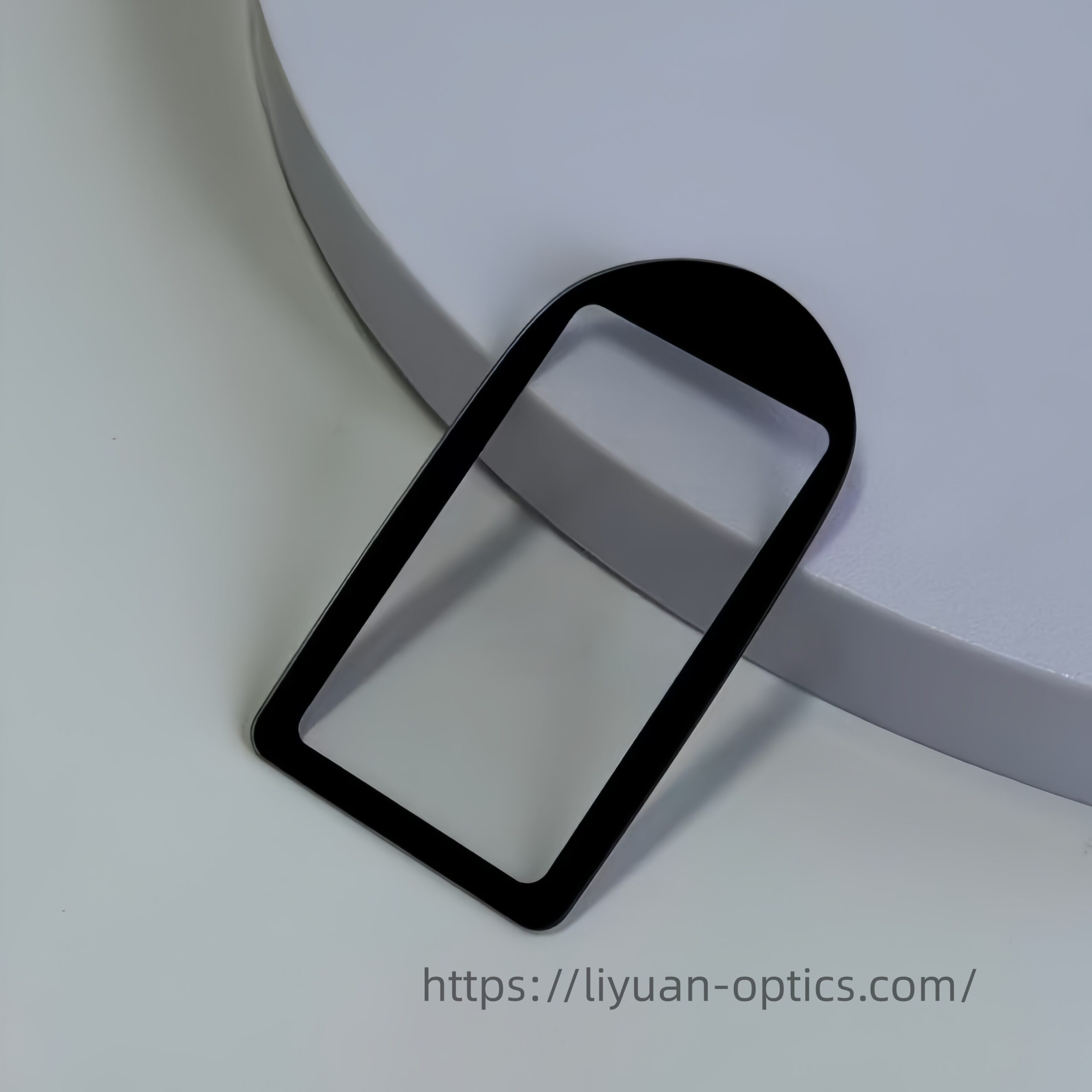
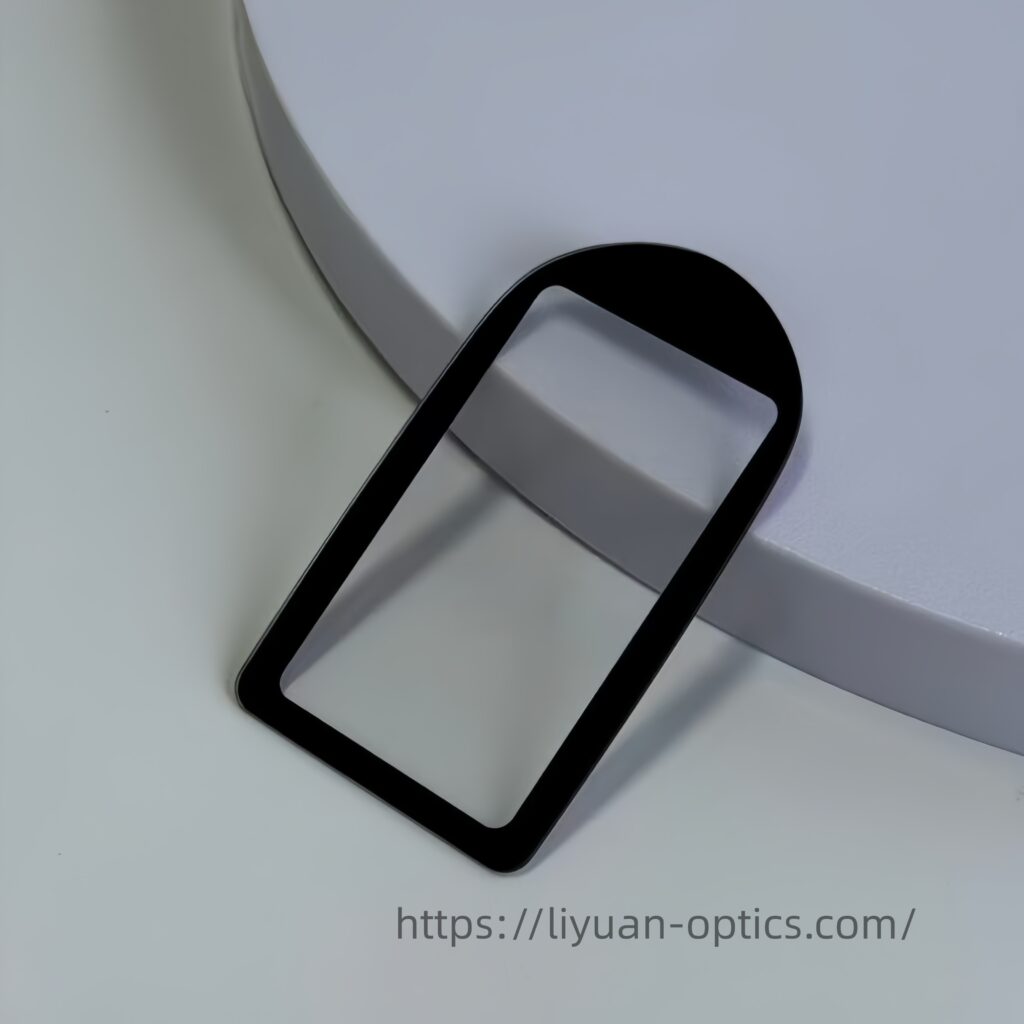
| Product Name: | Black Silkscreen Printed Window Glass |
| Type: | Optical Glass |
| Color: | Transparent and Black |
| Average Transmissivity(%): | 90%, 95% with AR coating for light transmitting window |
| Shape : | Square or Customized |
| Dimension(in mm): | 59.2×33.8mm |
| Thickness(mm): | 1.0mm |
| Material: | Optical Glass |
| Spectral range(nm): | 350-1100nm |
| Remark: Support customized for AF coating. | |
What are the main features of the protective window mirror of the skin detector?
A black silkscreen-printed glass window serves as an optical cover for skin detection devices and beauty instruments. It combines high light transmission with durability, image quality, and an attractive appearance.
Unlike ordinary glass covers, this component supports broadband transmission, typically across 300–1100nm, covering parts of the ultraviolet, visible, and near-infrared ranges.
Standard designs typically achieve over 90% transmittance. A single-sided anti-reflective (AR) coating can increase it to around 95%, while a double-sided AR coating can achieve over 98%. Some applications also require an anti-fingerprint (AF) coating to improve resistance to water, oil, and fingerprints.
Common substrate materials include ultra-clear glass, quartz glass and sapphire. The choice generally depends on the required optical performance, wear resistance, and mechanical durability.
Related products:
Shenzhen Hengda Liyuan Optoelectronics introduced advanced optical vacuum technology that apply depositing nano-materials through ion-assisted evaporation onto a multilayer hard film in a high vacuum environment which the coating layer is firm and has good tightness and small bandwidth drift. The company have been focus on optical coating for more than 17 years ,and the company offer one-stop optical filters solution including Narrow Bandpass Filters, IR cut-off Filters, Longpass Filters, Shortpass Filters, Notch Filters, ND filters, Star filters and Optical sapphire block.
Remark:Because the interference type filter varies its spectral performance at different angles, the spectral parameters usually determine its appearance color; moreover, the pictures in this link may originate from various shooting angles, so the actual color of the parts should therefore refer to the final spectral parameters required.